
You’re making decisions drunk.
Most of your worst decisions have something in common.
You weren’t thinking clearly. Not because you were stupid. Not because you lacked information. Because you were feeling something you hadn’t finished feeling yet.
And that unfinished feeling was driving.
I’m not talking about alcohol. I’m talking about emotional sobriety. The ability to feel what you’re feeling all the way through before you act on it. And almost nobody does this. Almost nobody even knows it’s an option.
There’s an old story that maps this perfectly – Adam and Eve in the garden. Most people read it as mythology. I read it as psychology. As a map of what happens inside you when feelings bypass your ability to contain them. (More on that in a minute.)
But first, we need to talk about what “feeling” actually means. Because there are two layers to this, and most people only deal with one.
Two Kinds of Feelings
The first kind is the big one. The obvious one. Someone cuts you off in traffic. Your boss says something dismissive. You read a text that hits wrong. The feeling arrives loud and hot and immediate.
This kind you can usually work with. A few conscious breaths. Some awareness directed at the sensation. Stay with it for a minute or two instead of reacting, and the chemical surge moves through. The cortisol spikes, the adrenaline fires, and if you give it space, it passes. You’re back online. Emotionally sober.
That’s the easy part. Or at least the more obvious part.
The second kind is the one that ruins your life.
Because reality is constantly poking you. Like an acupuncture needle finding every point in your nervous system where there’s trapped energy. Old stuff. Feelings you bypassed at fourteen because you didn’t have the awareness or the tools to process them. Grief you skipped over because there wasn’t space for it. Anger you swallowed because someone told you it wasn’t appropriate.
When a present-moment feeling hits – the loud, obvious kind – it doesn’t just trigger a chemical response. It knocks on doors. The rejection you feel right now wakes up every rejection your nervous system ever filed away and never finished processing. The current feeling is the acupuncture needle, and suddenly old material starts surfacing.
Here’s the problem: those old feelings don’t always show up loud.
They’re more like a low-grade hum. A background anxiety that’s just… always there. A low-grade frustration you can’t quite source. A subtle anger that never fully goes away. It’s not in the red zone of your emotional rev meter, so you don’t treat it like something that needs attention. You just assume that’s how life feels. That everyone walks around with this low hum of unease.
They don’t.
That hum is unfinished business. Trapped emotional energy from moments your system tried to bring to the surface but you bypassed – again – because it wasn’t screaming loud enough to force you to deal with it.
Life keeps bringing it up. That’s what life does. It waits until you have enough consciousness and enough space, and then it serves the old feelings back to you for completion. But because they arrive as a whisper instead of a scream, most people just… let them hum. For years. For decades. They build a life on top of that hum and call it normal.
If you can learn to drop down into the hum – to actually give it attention, to breathe into it the way you would with a loud feeling – it gets louder. Which sounds like bad news but it’s actually the point. It gets louder because you’re finally letting it speak. And when you let it speak all the way through, it completes. It metabolizes. It’s done.
And suddenly you have more bandwidth. More emotional capacity. The space that feeling was occupying is now available for presence, for creativity, for clear thinking. For decisions that are actually yours. This is what emotional sobriety creates – space where reactivity used to live.
The book of Job maps this better than anything I’ve found. Job doesn’t process his grief quickly. He sits in ashes for seven days before he even speaks. Then he endures chapter after chapter of feeling – rage, despair, confusion, the desperate need to understand why – while his inner voices (disguised as friends) try to rush him through it. “Just repent.” “Just accept it.” “Just figure out what you did wrong.”
But the whole point of Job is that the feeling has to run its full course. Not just the loud stuff. The deep work. The trapped material underneath that’s been waiting years for a door to open. And the reward for sitting with all of it – as long as it actually takes – is expanded emotional capacity. Job ends up able to hold twice what he could before. Not because he figured anything out. Because he let himself feel the full weight without running.
So there are two practices here. One for the loud feeling: breathe, stay present, give it a minute or two, let the chemical surge pass before you act. And one for the hum: drop into it on purpose, give it permission to get louder, and let it complete. Both are emotional sobriety. Both are the difference between making decisions drunk and making decisions clear.
The Adam and Eve Framework
Now back to Genesis. Because it maps both layers perfectly.
Here’s how I read it: Adam represents your conscious mind – the container, the part that holds space. Eve represents your feeling nature – the part that experiences, desires, responds to what’s alive in the moment.
In the garden state, they work together. Eve feels, Adam contains, then together they act. Head and heart in the right order. This is emotional sobriety as an inner architecture.
The fall is what happens when feeling bypasses containment. Eve sees the fruit. It looks good, feels necessary, seems like the answer. But instead of Adam creating space for that feeling to process first, she acts. The emotion becomes a decision before the container can hold it.
When your big feelings act before your conscious mind can create a container for them, you make decisions from unprocessed urges. That’s Genesis 3 in a sentence.
What Emotional Sobriety Actually Looks Like
The term comes from AA. Bill Wilson wrote a letter about it near the end of his life. He’d been sober from alcohol for decades but realized he was still emotionally wasted. Still making reactive decisions from fear and resentment. Still letting unprocessed feelings run the show.
He called it “emotional sobriety” and said it was harder than putting down the drink.
I think he was right. And I think it applies to everyone, not just people in recovery.
Emotional sobriety isn’t the absence of feeling. It’s the opposite. It’s feeling the feeling completely, in your body, without letting your mind turn it into a project.
That knot in your stomach when you read the text? Feel it. Don’t respond yet.
The tightness in your chest when your boss gives you that look? Stay with it. Let it move.
The wave of shame when you remember something from ten years ago? Don’t push it down. Don’t analyze it. Just let it be there until it isn’t.
And that low-grade anxiety humming underneath everything? That’s the real work. That’s the invitation most people decline for their entire lives. That’s where emotional sobriety goes from a concept to a practice.
Why Emotional Sobriety Is So Hard
Because we were trained to do the opposite.
“Don’t cry.” “Calm down.” “You’re overreacting.” “Be rational.” Every message you got as a kid was some version of: your feelings are a problem to be solved, not an experience to be had.
So you learned to skip them. Go straight to thinking. Straight to fixing. Straight to controlling.
And it works. Sort of. For a while. Until your jaw is clenched at 3am and you can’t sleep and you don’t know why. Until you snap at someone you love over something that doesn’t matter. Until the doctor says your blood pressure is too high for your age.
Your body keeps the tab. It always keeps the tab.
This is life in exile. East of Eden. The place where everything becomes effort and striving because you’ve lost the ability to receive what’s already flowing toward you. Where provision feels scarce because trust died. Where the hum is so constant you’ve stopped noticing it’s there.
The Drunk Decisions
Think about the last decision you regret.
The email you sent too fast. The argument you escalated when you could’ve paused. The relationship you ended (or didn’t end) because something in your chest was screaming and you mistook it for clarity.
You were emotionally drunk. The feeling was so loud it felt like truth. But feelings aren’t truth. They’re information. They’re your body saying “something’s happening here.” The feeling is the notification, not the message.
Genesis puts it like this: “Eve saw that the tree was good for food, and that it was a delight to the eyes, and that the tree was to be desired to make one wise, she took of its fruit and ate.”
The fruit looked good. It looked nourishing. It looked like the answer. Your drunk decisions probably look the same. Reasonable, even necessary, until you realize what you traded for them.
And sometimes it’s not even a loud feeling that gets you. Sometimes it’s the hum. That low-grade anxiety making you say yes to things you should say no to. That background frustration making you sharp with people who don’t deserve it. You’re not drunk on a big feeling – you’re drunk on the accumulated buzz of every small feeling you never processed.
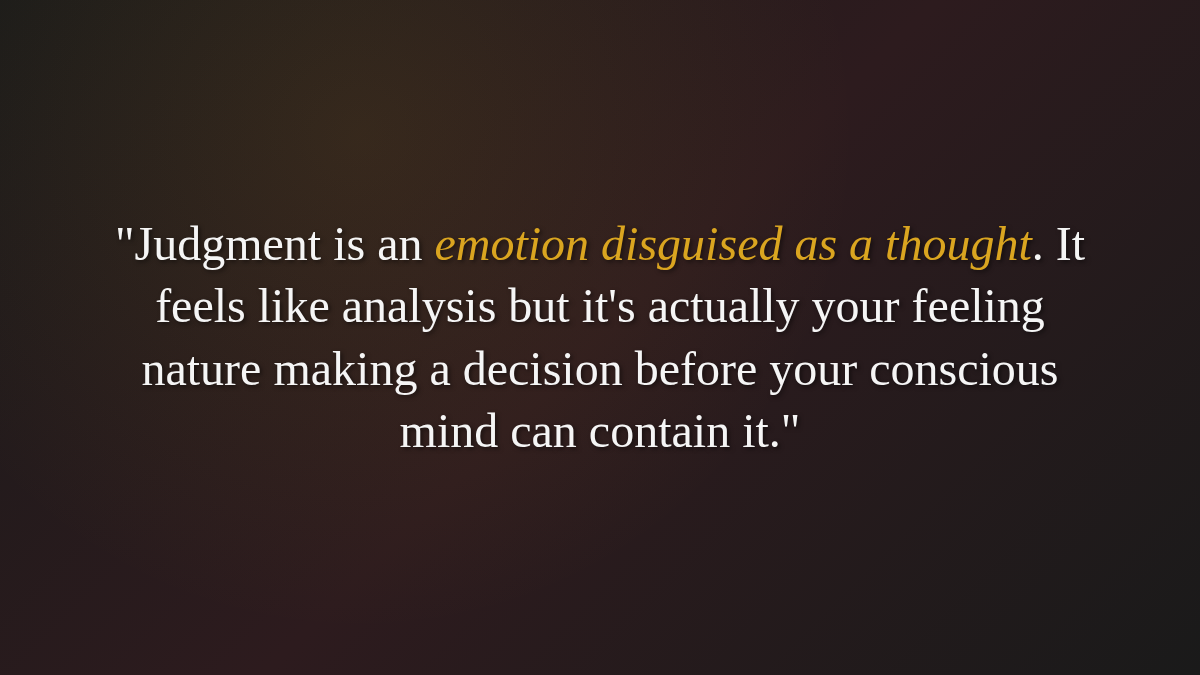
Judgment is an emotion disguised as a thought. It feels like analysis but it’s actually your feeling nature making a decision before your conscious mind can contain it.
Sobriety is reading the message before you reply.
How to Practice Emotional Sobriety
It’s embarrassingly simple. Which is probably why nobody does it.
For the loud feelings: when a strong emotion hits, stop. Don’t do anything. Put your hand on your chest or your stomach, wherever the feeling lives. Breathe into it. Not deep therapeutic breaths. Just normal breathing, directed at the sensation. Stay with it for a minute or two. The chemical surge will pass, and you’ll be able to think clearly before you act.
For the hum: this takes more intention. Find a quiet moment and drop your attention into your body. Not your thoughts about your body. Your actual body. Notice what’s there. The tightness in your shoulders you’ve been ignoring. The knot in your gut that’s been there so long you forgot it was unusual.
Breathe into it. Give it permission to be louder.
You’ll notice something strange. When you give the hum attention, it intensifies. The low-grade anxiety becomes actual anxiety. The background sadness becomes real sadness. This is the feeling finally being allowed to speak after years of being told to keep it down.
Let it speak. Let it get as loud as it needs to. It might shift – the anger melts and underneath it is sadness. The sadness melts and underneath it is loneliness. The loneliness might sit there for a while, because it’s not just today’s loneliness. It’s every time you felt alone and pushed it away.
Let it stay as long as it needs to. The quiet comes when the feeling has been fully received. Not when a clock says so.
That quiet is emotional sobriety. And the bandwidth it frees up is the whole point.
This is Adam learning to hold space for Eve. Your conscious mind creating a container for the big feeling so it can process and transmute back into creative potential before you act. And your conscious mind learning to go find the quiet feelings too – the ones that aren’t demanding attention but desperately need it.
When you’re in the garden state, this happens automatically. When you’re in exile, you have to practice your way back.
The Ancient Pattern of Every Emotional Relapse
Here’s what I find wild about Genesis 3. It maps the exact anatomy of every emotional relapse.
The doubt arrives first: “Did God actually say?” That voice at 3am asking if you’re sure you’re on the right path. If you really belong. If this is working.
Then the promise: “You’ll be like God, knowing good and evil.” You’ll finally have the thing that makes you complete. The achievement, the purchase, the relationship that fills the hole.
Eve had everything. A garden that provided. A partner. Access to the tree of life. But the serpent showed her what she didn’t have. And suddenly the abundance felt like lack.
This is where provision anxiety lives. The feeling that there isn’t enough. That you need to grab your share before someone else gets it. That wholeness requires something you don’t currently have.
The reach happens when feeling bypasses containment. She saw, she desired, she took, she ate. Emotion straight to action without processing.
Then comes the covering. Fig leaves sewn into hiding. The shame that rushes in after the choice you wish you hadn’t made. The immediate need to conceal what you’ve become.
And finally the blame. Adam points at Eve. Eve points at the serpent. Nobody says simply: I chose this. I reached. I took. I ate.
You’ve lived this pattern. The voice that questions what you know. The promise of becoming more. The reach for what wasn’t yours to take. The shame. The covering. The blame.
This is what happens when your emotional states run the show instead of your rational mind creating space for them first. This is life without emotional sobriety.
The Part That Changed Everything for Me
I used to think emotions were binary. You either felt them or you controlled them. Good people controlled them. Mature people controlled them. Spiritual people controlled them.
That’s backwards.
The most emotionally sober people I know aren’t the ones who stay calm. They’re the ones who feel everything and don’t let it drive. They cry at the table. They sit with rage without throwing it at someone. They let grief come when grief comes, even if the timing is inconvenient.
They’re sober. Not because they stopped feeling. Because they stopped running from it.
And they don’t just deal with the loud feelings. They go looking for the quiet ones. They notice the hum and drop into it instead of building their life around it. That’s the difference. That’s the advanced practice of emotional sobriety.
And their decisions are different. Clearer. Slower. More honest. Less reactive. More bandwidth available for the things that actually matter.
I think this is what every spiritual tradition is actually trying to teach. Not transcendence. Not escape. The willingness to be fully here for what’s happening in your body right now. Even when it’s awful. Especially when it’s awful. Even when it’s just a whisper you’d rather ignore. It’s what I keep finding in every book of the Bible I open.
The garden is always available. Not through going back to unconscious innocence, but through choosing presence on purpose. Through learning to let Eve feel fully while Adam holds space. Through emotional sobriety.
Because the feeling won’t kill you. But the running might.
The story promises something. The offspring will crush the serpent’s head. Something born of your feeling nature, when properly contained, will silence the voice that started all this doubt. The voice that whispers you’re on your own. That nobody’s coming. That you have to figure this out yourself.
Processed emotion eliminates doubt. Felt feelings, fully held, produce the kind of certainty that can’t be shaken.
The exile is making you into someone who can return consciously. Someone who can choose the garden state not because they never broke, but because they know what it costs to leave.
The way back isn’t back. It’s through.
Jon Ray writes about emotional sobriety, mystical readings of scripture, and using AI as a tool for self-discovery. His Mystical Bible series is available at whoisjonray.com.