
Listen while you workout, cook, or commute.
I told Claude Code to scrape the Wayback Machine API and find everything I’ve ever written online.
18 years of mystical, metaphysical, emotional stuff. Most of which I’d deleted.
Why? Because every time I was about to book a big client or go in for a corporate consulting gig, I’d get this tightness in my chest and pull the whole blog down.
Get the gig, finish the work, spin it back up at a different URL.
Repeat for almost two decades.
I was afraid to be me. Afraid that “being me” wouldn’t be profitable.
By presenting a metallic facade to my clients, they didn’t get to experience my full genius zone. They got a watered down version of me. And I kept putting myself in a cage.
Now I’m realizing that “being authentic” and letting the chips fall where they may is how you actually land opportunities that have deep alignment in multiple domains of life.
“Authenticity” becomes a filtering mechanism so you don’t end up working with “bad clients” who paid on time but were clearly not a fit from the get go.
The Technical Walkthrough: How I Did It
Here’s exactly what I had Claude Code do:
Step 1: Scrape the Wayback Machine API
I gave Claude access to my terminal and pointed it at the Wayback Machine’s CDX API. The prompt was simple: “Find every URL I’ve ever published under these domains.”
The API returns every snapshot ever captured. For me, that was hundreds of URLs across multiple domains I’d owned over the years.
Step 2: Filter for Ego vs. Insight
This is where it got interesting. I asked Claude to sweep through the recovered content and flag anything that was clearly ego-first writing. You know the type: hot takes designed to get attention, contrarian posts for the sake of being contrarian, anything that felt performative rather than true.
The goal was to keep anything that felt like an actual insight. Something I’d learned. Something I’d want to remember.
Step 3: Build the Time Machine Widget
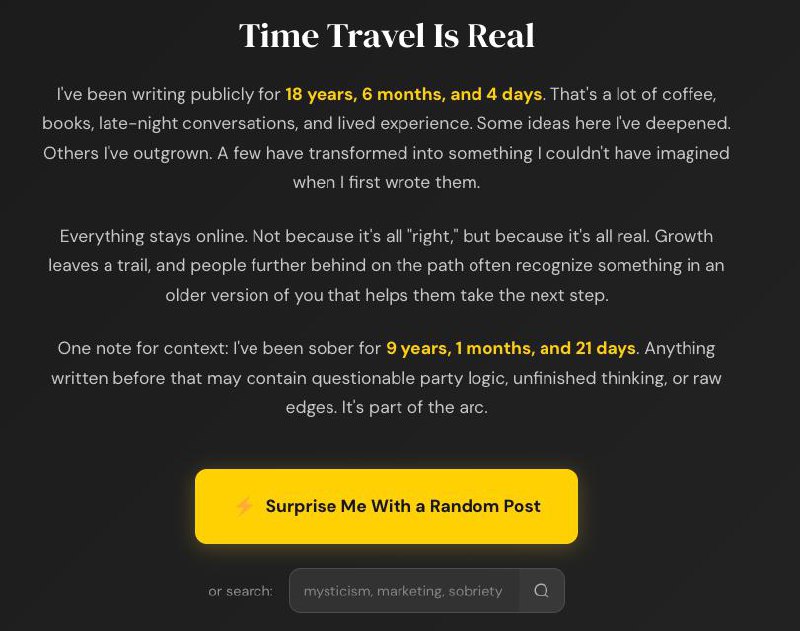
Claude built a WordPress widget that surfaces old posts on my homepage. Every time someone visits, they see a random post from my archive. It’s like a “time machine” into my past thinking.
The widget pulls from a custom post type and randomizes the display. Simple, but effective.
Step 4: Train My Voice
All of this recovered writing is now “the voice” that I tell AI to train on as I’m writing books and tweets and thinking out loud. It’s my narrative arc, distilled into something usable.
What I Found
I find it fascinating to read my old thinking from a new perspective.
Many posts have deep insight that seems smarter and more wise than I am now. Some are just fun and I’ve clearly evolved away from those ideas. But all of it is interesting.
I’ve been writing publicly for 18 years, 6 months, and 3 days.
Some ideas I’ve deepened. Others I’ve outgrown. A few have transformed into something I couldn’t have imagined when I first wrote them.
Everything stays online now. Not because it’s all “right,” but because it’s all real.
Growth leaves a trail, and people further behind on the path often recognize something in an older version of you that helps them take the next step.
One Note
I’ve been sober for 9 years, 1 month, and 20 days. Anything written before that may contain questionable party logic, unfinished thinking, or raw edges. It’s part of the arc.
Try It Yourself
If you want to excavate your own digital past, the Wayback Machine CDX API is free and well-documented. Point Claude Code (or any coding AI) at it with your old domains, and see what comes back.
You might be surprised what you find.